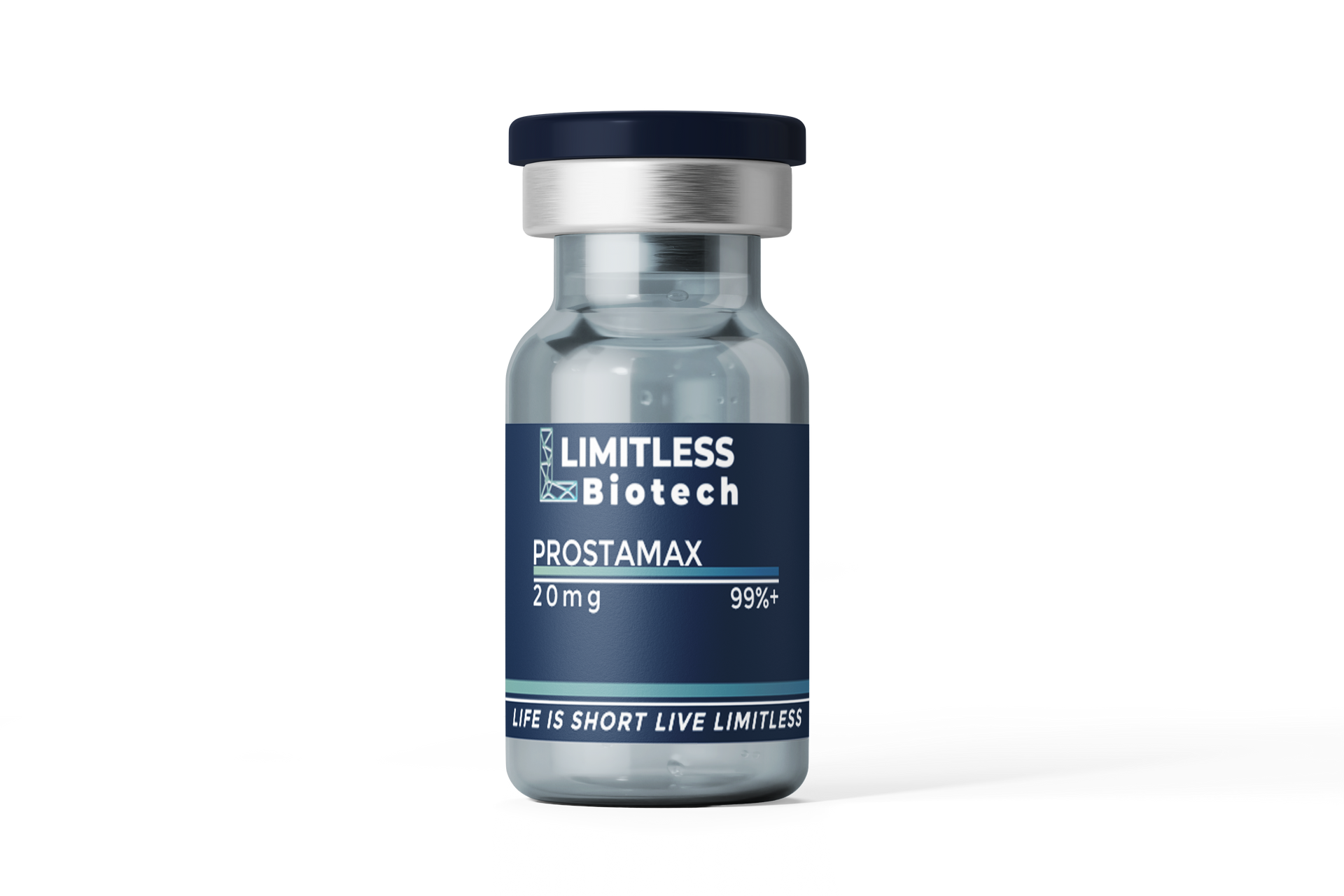
Prostamax

$62.99

✓ Third-party tested by certified labs ✓ Published certificates of analysis ✓ ≥98.5% purity standard

Category:

Description

Prostamax Peptide Description

Prostamax is a synthetic Khavinson bioregulator peptide with profound effects on DNA condensation in a number of cells. The peptide was developed by Vladimir Khavinson, a leading scientist who has authored 196 patents and 775 scientific publications in the field of peptide bioregulation and anti-aging research.

Researchers investigating DNA condensation, gene expression modulation, and cellular aging mechanisms will find Prostamax essential for examining how short peptides influence chromatin structure in lymphocytes and prostate cell cultures.

Research Applications

  • Chromatin Studies
  • Cellular Aging
  • Prostate Research
  • Epigenetic Regulation
  • Chronic Inflammation Pathways

Container:
Glass Vial
Presentation:
White lyophilized powder
Sequence:
Lys-Glu-Asp-Pro (KEDP)
Molecular Formula:
C₂₀H₃₃N₅O₉
Molecular Weight:
487.5 g/mol
PubChem CID:
9848296
Synonyms:
SCHEMBL6660498
IUPAC Name:
(2S)-1-[(2S)-3-carboxy-2-[[(2S)-4-carboxy-2-[[(2S)-2,6-diaminohexanoyl]amino]butanoyl]amino]propanoyl]pyrrolidine-2-carboxylic acid
Storage:
This lyophilized preparation is stable at room temperature when guarded from light, but should be kept at -20°C for long term storage, preferably with desiccant

At Limitless Biotech, we provide comprehensive Certificates of Analysis (COAs) for all of our research-only peptides to ensure transparency, purity, and quality in every batch. Each COA includes detailed analytical data that allows researchers to verify identity, concentration, and integrity, supporting reliable and reproducible scientific work. Our commitment to rigorous testing helps researchers move forward with confidence in the materials they use.

Lyophilized Prostamax #1252 Purity COALyophilized Prostamax #1252 Sterility COALyophilized Prostamax #1252 Endotoxin COA
Research

Prostamax (Lys-Glu-Asp-Pro) Research

Laboratory studies have shown Prostamax’s capacity to modulate inflammatory responses, reduce tissue scarring, and support reparative processes in prostate cell cultures. Its mechanism involves targeted interaction with cellular receptors, making it ideal for researchers studying peptide-mediated tissue repair, anti-inflammatory signaling, and cellular longevity pathways.

Summary Table: Key Findings on Prostamax

Effect/Outcome Evidence/Description
Chromatin decondensation Increases SCE, Ag-NORs, reduces heterochromatin; releases repressed genes in aging cells
Anti-inflammatory in prostatitis Reduces inflammation, prevents sclerosis/atrophy, enhances sexual activity, superior to comparators
Reparative tissue stimulation Stimulates repair in prostate tissue cultures from young and old rats
Chromatin remodeling in elderly Activates ribosome genes, decondenses chromatin, especially in chromosome 1

Chromatin Modification

Prostamax alters chromatin structure in cells from elderly individuals by increasing the frequency of sister chromatid exchanges and Ag-positive nucleolar organizer regions (NORs), while reducing large segments of pericentromeric heterochromatin[1]. These changes suggest Prostamax promotes chromatin decondensation and deheterochromatinization, potentially reactivating genes that are repressed during aging. This chromatin modification is proposed as the basis for Prostamax’s protective cellular effects[1].

Therapeutic Effects in Chronic Prostatitis

Experimental studies demonstrate that Prostamax is effective in treating chronic aseptic prostatitis. It reduces inflammation markers such as swelling, vascular hyperemia, and lymphoid infiltration, and prevents sclerotic and atrophic changes in the prostate[2]. Prostamax is also shown to enhance sexual activity in animal models and outperforms commonly used prostatotropic agents derived from Serenoa repens and animal prostate extracts[2]. At low concentrations, Prostamax may also promote tissue repair in the prostate, suggesting potential clinical applications for age-related tissue degeneration[3].

Comparative Effects with Other Peptides

In studies involving elderly subjects, Prostamax and other short peptides (Vilon, EpitalonLivagen, Cortagen) activate ribosome genes, decondense densely packed chromatin, and release genes repressed by age-specific chromatin condensation. Prostamax specifically induces decondensation in chromosome 1 pericentromeric regions, highlighting its role in chromatin remodeling in senile cells[4].

References

  1. Dzhokhadze, T., Buadze, T., Gaiozishvili, M., Baratashvili, N., & Lezhava, T. (2012). [Deheterochromatinization of the chromatin in old age induced by oligopeptide bioregulator (Lys-Glu-Asp-Pro)].. Georgian medical news, 212, 76-82.
  2. Borovskaya, T., Pakhomova, A., Vychuzhanina, A., Poluektova, M., Fomina, T., Ermolaeva, L., Schemerova, J., Granstrem, O., & Neplochov, E. (2013). Experimental studying of the drug efficiency Prostamax in the therapy of chronic aseptic prostatitis and its complications. , 2, 54-58. https://doi.org/10.4236/MRI.2013.23007.
  3. Zakutskii, A., Chalisova, N., Ryzhak, G., Aniskina, A., Filippov, S., & Zeziulin, P. (2006). [The tissue-specific effect of synthetic peptides-biologic regulators in organotypic tissues culture in young and old rats].. Advances in gerontology = Uspekhi gerontologii, 19, 93-6.
  4. Khavinson, V., Lezhava, T., & Malinin, V. (2004). Effects of Short Peptides on Lymphocyte Chromatin in Senile Subjects. Bulletin of Experimental Biology and Medicine, 137, 78-81. https://doi.org/10.1023/B:BEBM.0000024393.40560.05.

Reviews

There are no reviews yet.

Be the first to review “Prostamax”

Your email address will not be published. Required fields are marked *

Related products